Format Hard Drive For Mac
Does adobe spark have a desktop app for mac. • Select whether you want to create a Page, Post, or Video. If you’re starting from scratch, there are helpful templates that address a wide variety of projects such as fliers, explainers, photo journals, teach a lesson, and more. • When you finish your project, it can be directly uploaded to Twitter and Facebook (for olders), downloaded as a JPG, accessed via link (for Spark Video), or downloaded as an MP4 (for Spark Video). These are three different project options that align with either the three options on your desktop Adobe Spark website or the three different apps you downloaded to your mobile device. • Once you’re logged in, access My Projects and either continue work on a project or start a new one.
Looking to share an external hard drive between a Mac and PC? The best way to do it is with a drive formatted as FAT32. Though this format has some limitations, it enjoys nearly universal support from active platforms, including Mac and Windows operating systems, and many gaming and Linux OSs. The chief drawbacks of FAT32 involve file and partition size limitations. FAT32 imposes a size limit of 4GB on single files.
So if you work with bulky video clips, for example, adopting FAT32 may not be a good idea. When formatting partitions, Windows 7's Disk Management utility won't let you create one that's larger than 32GB, whereas Mac OS X Lion can create partitions as large as 2TB using its Disk Utility application. Finally, Mac OS X's Time Machine backup utility won't work with FAT32. Windows prefers to use NTFS (which stands for New Technology File System, though it has been around for nearly 20 years now). Macs running Snow Leopard or Lion can read from drives formatted as NTFS, but they can't write to such drives unless you install a third-party driver or muck about in the Terminal. Conversely, Windows 7 can't read and write to drives formatted as HFS+--also known as Mac OS Extended (journaled)--unless you install third-party software.
Formatting From a Mac To format a drive as FAT32 from a Mac, follow these simple steps. Set up your drive following the manufacturer's instructions. Connect the power supply (if necessary), connect to the Mac via USB or FireWire, and turn on the drive.
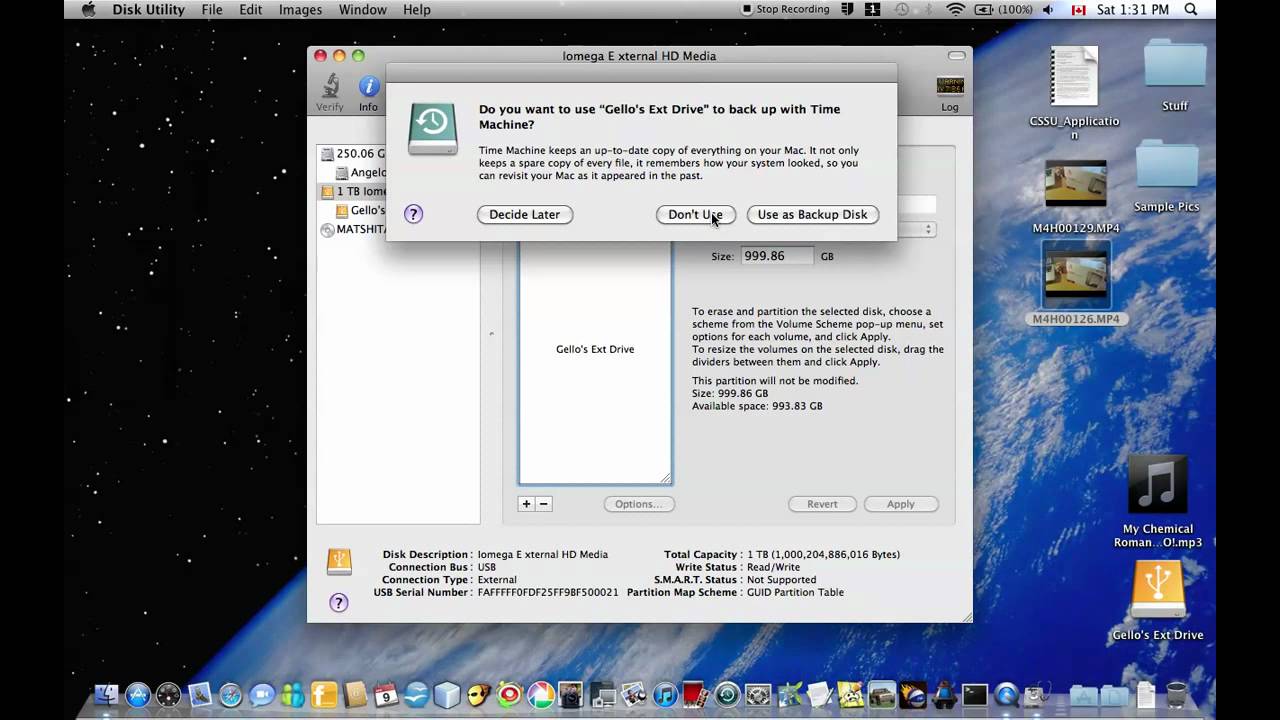
The drive should automatically mount on your Mac's desktop (if the finder preferences are set to show external drives). If the drive is not formatted, you may get a message saying that the drive is unreadable by Mac OS X and asking you whether you want to format it via Disk Utility. We're going to do this anyway, so open Disk Utility from the prompt or by navigating to /Applications/Utilities. Select MS-DOS (FAT) as the format. Mac OS X won't let you create a FAT32 partition larger than 2TB; so if your drive is larger than that, you'll need to divide the available drive capacity into multiple partitions. You can format the remaining space as a second FAT32 partition or as an HFS+ partition, or you can leave it as unallocated space. To create a new partition, click the drive in the list on the left side of the Disk Utility menu.
Format external drives to Mac OS Extended before using with Aperture Tips on preparing a new external hard drive for use with Aperture. You may wish to use an external FireWire or USB hard drive to store your Aperture Library, referenced images, or Vaults. How can the answer be improved?
Click the Partition button in Disk Utility's main window. By default, Mac OS X will use the GUID partition table to format the drive. You can use this and still share FAT32 volumes with a PC, but if you'll primarily be using the drive with Windows, and if the full capacity of the drive doesn't exceed 2TB, the wiser course is to wipe the drive and then use Windows' Master Boot Record (MBR) partition scheme. Establishing the partition layout. Click the Partition Layout drop-down menu in Disk Utility, and select the number of partitions you want to create. Cbd reader for windows 8.
Connecting to verizon email with outlook for mac 2011. Its not a software bug, its due to you using an old Office version that was released prior to the new screen display types, and as such cannot cope with that display type Office 2007 actually goes out of support later this year.
By default, Disk Utility will divide the available space in half. You can resize the partitions by clicking the line between the partitions and dragging it up or down to increase or decrease the capacity of one or the other side.
Click on whichever partition segment you want to format as FAT32. Type a name for that partition in the Name field and choose the FAT32 option from the Format drop-down menu. Once everything is arranged as you want it, click apply. A progress bar will appear at the bottom right of the window as Disk Utility creates the requested partitions. Once it finishes creating them, you can move the drive between Macs and Windows PCs, and move files back and forth easily.
Formatting From a PC Select your hard drive, and choose 'Convert to MBR Disk'.Here's how to create a FAT32 partition from a Windows 7 PC. Open the Disk Management utility. To do so, select Start, Control Panel, System and Security, Create and format hard disk partitions. Alternatively, press the Start button and start typing partitions. Find the drive you'd like to format; in my case, it was Disk 5. Click the disk number, and select Convert to MBR Disk ('MBR' stands for 'Master Boot Record'). Right-click the unallocated segment in the next field over, select New Simple Volume, and click Next when the wizard launches.